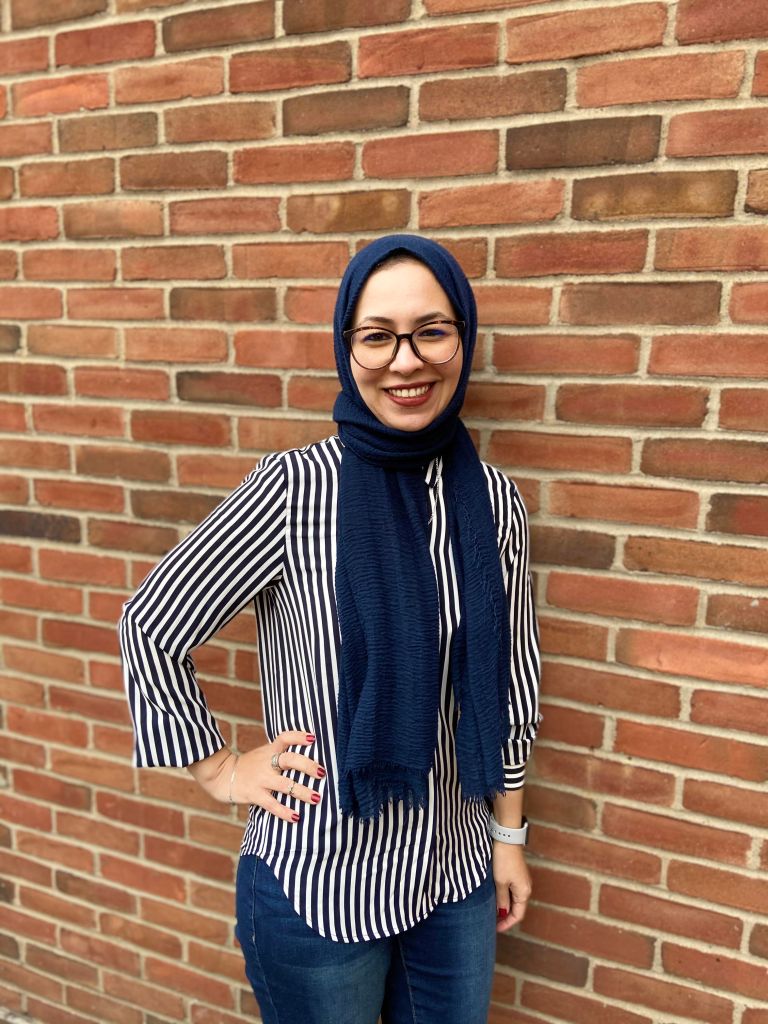
Sahar first came to the U.S. in 2008 in pursuit of Master’s degree in English literature. At the time of our interview in May 2019, she was pursuing a PhD in English Literature at Indiana University of Pennsylvania (IUP).
Where are you from?
“I am from Jordan, officially, but I am Palestinian, like [in] origin. […] My parents were born in Palestine, and after the war in 1967 they became refugees in Jordan. Actually, my grandparents, because we’re from Yaffa, after the 1948 war they became refugees in the West Bank. And then with the second war, my parents became refugees, and my grandparents became refugees again. And then they moved to Jordan. They were forced to move to Jordan, in camps, and they were expecting to go back, but with politics and war they were not able to go back. So Jordan offered them the Jordanian citizenship and that’s why they became Jordanians by passport.”
How does your family feel about you being so far away?
“They’re used to it now. […] My dad is my cheerleader, he’s always supported me, and he’s, I think he saw the potential in me and he saw that I’m capable of going places, and he told me that in person. He’s like ‘Even if you want to go to China, just go. I trust you, I believe in you, I believe in what you can do.’ And my mom, you know mothers are so emotional. The first time I moved, they were happy for me, they knew how much I wanted to travel and come to the US and do stuff. So they were happy for me, but I remember like whenever we talked over the phone, like my mom would cry and my dad would have tears, but then they got used to it.”
“I’ve been away from home since 2008, which is like 10 years now, even more. So they’re used to it. Even they call me ‘Sinbad’. And whenever I go back home, [they are] like ‘How do you describe the services of our hotel?’ [laughs]. So their house is a hotel. So they’re used to it now.”
“And [when I started my PhD in the] US it was very, very tough, especially for my dad. […] We’re best friends. […] And especially because they knew that PhD is gonna be a long journey and I would be away for at least 5 years, that’s why it was difficult for him. And my mom was you know patting dad [saying] ‘It’s ok, she will come back’. But it took them a while to get used to it, but now they’re fine.”
How often do you get to see or talk to you family in Jordan?
“I try my best to go [to Jordan] every summer, every year. But last year I did not go, so it’s been two years now since I saw them in person. But we talk on the phone at least once a week. And it’s not even the phone, we do video calling on [Facebook] Messenger and like we talk for at least three hours, sometimes four hours. So for sure once a week, but sometimes we do twice a week, it depends on what’s going on.”
What does it mean to you to be Muslim?
“I envision a Muslim woman as someone who does not cause any harm to anyone. Someone who, if you hang out with, you would leave happy and you would look forward to meeting next time. […] She’s interesting. And she does not judge; she’s accepting. So that’s what I hope people would say about me as a Muslim woman. […] That’s what I hope I am as a Muslim woman.”
“In terms of faith and beliefs, someone who believes in God, someone who makes sure that, let me talk about myself, I hope that I, as a Muslim woman, always go back to those spiritual beliefs that I’ve grown up reading about and experiencing. And I know it’s difficult; especially in the US to sometimes [I] just lose that spirituality because it’s such a different environment, and because we are minority here too, like, we don’t have that big community, so it’s easy to lose that part, spiritual part, in you. And I’ve noticed that there were like ups and downs in my life, in that regard. And so what it means to be a Muslim, like I always go back, always go back, always go back, regardless of how many times I like go astray, I just go back because I don’t want to lose that connection. Because it’s something that I am proud of, to be honest. And it’s something that makes me feel at peace inside, like when it’s night, when it’s silent, when it’s a dark outside, when you are left on your own, it’s only that part that makes me feel at peace, that I have something, I have this purpose in life that it keeps me grounded that belief. So that is what I like to envision as, you know, what it means to me is that it centers me into the world. That belief that like, yeah, no, I’m in safe hands too, because I’m Muslim. In safe hands in that power. So I’m fine.”
Have you ever felt like you were a target of Islamophohobia?
“I mean several times and not felt, but I was at target. Yeah. I was once called at the parking lot at the mall. The car was driving and I was with my friend, […] and we were called out, like go back to your countries. And one time I was given the middle finger in the car.”
“But on the other side, I had people reach out actually to me like in Walmart and Martin’s [grocery store]. One old lady pointed at my scarf and she knew the name, I mean, she said it wrong in a funny way. I forgot how she said it. She did not say hijab, but she said hajab, something, you know, but she knew the word and she’s like, ‘Oh, it’s sparkling. I love it. You look beautiful’. And she did not even ask me where I’m from or not. No, she’s just pointing out that it’s beautiful and she knows it. […] So I really appreciate that woman. I love that gesture.”
“So, yes, some people might harass you, but some on the other side, people welcome you, they are very welcoming. […] But in general, I feel safe in Indiana. I don’t feel that I’m a target. […] There are people who are willing to be friends with people who are unlike them. And I’ve felt that, and I’ve seen that here, so I feel safe. Like I go at whatever time on my own, doesn’t have to be with friends and yeah, people would just smile and welcome. So yeah, it’s safe. I’d like to believe that.”
Given everything that’s going on in the world and particularly the anti-Muslim rhetoric in the United States, does that have an effect on you?
“I had this conversation with [my friend], both of us agreed actually that it seems that there is no safe place anymore for us. We are target everywhere. […] I don’t know how I feel about it. Like sometimes I’m optimistic. I hate to be pessimistic and I hate to see the bad side all the time. […] I feel that no, there is something good. People, good people, exist. […] But whenever we say it’s not going to be any worse, something worse happens. Even in Europe. And you see in China, like Muslims are imprisoned and in camps and they’re not allowed to fast and they’re tortured just because they’re Muslims. No one knows about them. Just, you know, bits and pieces here and there from news. No one’s doing something about it. It looks depressing. We’re definitely target[ed]. Islamophobia is rising. Unfortunately. We might not see it directly, but when we read about it in the news, it’s there. It’s affecting other people. […] We might not feel it or experience it firsthand, but it’s affecting other people. But I believe, as I said, I’m optimistic and I believe that good people [and] common sense will win. […] I don’t see it as, you know, dark, gloomy future. No. Life goes on and as long as you’re doing good things, and you are willing to work hard for it, you’re diligent to do changes, and some people are doing changes, we’re safe, I think.”
Are you hopeful for the future?
“Definitely. Yeah. I’m always optimistic. […] I feel that we are like, [in] this the movie where evil’s tying to take over. And I feel that it’s, we are this time, like, wherever you look like, what’s going on? […] I feel that, you know, that the evil power is trying to take over and the heroes, they’re weak, at the weakest point. But every movie, like at the end we take over and then we end the movie, we leave theaters happy that yes, we won, we took them down. So I like to think of it the same way. So I see a future in these [students I teach], they know what’s up, that they’re not naïve anymore. They believe that something wrong happened, and they know that they are the ones who will, you know, correct it and make it right. So I see that from American students. So yes, that’s why I’m optimistic and hopeful all the time, regardless of how dark it looks like. […] I would lose my sanity if it were not for hope, there is this line, poetry line, I like:
ما أضيق العيش لولا فسحة الأمل
Like ‘how tight and miserable life is were it not for this peek of hope.’ So, yes, I will, you know, stick to this fusha al-amal, peek of hope so I can live. I’m very hopeful, very optimistic.”
 Muslims in PA